
What does a new boat acutally cost?
Published:
Buying a new boat can be exciting right up until you start comparing prices. One boat might cost $30,000, another $50,000, and another $80,000 or more,
and they may look surprisingly similar at first glance. The difference usually comes down to size, construction, engine, features, and how the boat is equipped.
- New boats can range from around $20,000 to well over $100,000 depending on the type and equipment.
- The price of the boat itself is only part of the ownership cost.
- The best boat isn't necessarily the most expensive one. It's the one that fits how you actually plan to use it.
What Does a New Boat Actually Cost?
There isn't one simple answer. A smaller fishing boat might start in the $20,000 range, while a premium pontoon or tritoon can easily reach $50,000, $75,000, or more. Larger, heavily equipped boats can climb well into six figures.
Those numbers can change based on the model, year, engine, equipment, promotions, and availability, so it's better to think of them as general starting points rather than hard price categories.
The more important question isn't simply, "How much does a boat cost?" It's "What am I getting for the money?"
A $40,000 boat and a $60,000 boat may both get you on the water, but they may be designed for very different boaters. One might be built primarily for fishing while the other is designed for entertaining a large family. One might have a smaller outboard and basic electronics while the other has a larger engine, upgraded seating, premium electronics, and additional features.
Understanding those differences is what makes comparing boats worthwhile.
What Makes One Boat More Expensive Than Another?
Boat prices are affected by a lot more than length.
Size is one obvious factor. A larger boat generally costs more because you're getting more passenger capacity, storage, seating, fuel capacity, and often a larger engine. But bigger isn't automatically better.
If you're fishing with one or two people on smaller lakes, you may not need a 22-foot boat. If you're regularly taking a large family out for the day, paying more for additional space may make perfect sense.
The engine is another major factor. A boat equipped with a 90-horsepower outboard will generally cost less than the same boat equipped with a 200-horsepower engine. But the cheapest engine isn't necessarily the best choice.
Think about how you actually plan to use the boat. Are you mostly cruising? Fishing? Pulling tubes? Carrying a large group? Spending time on larger reservoirs?
The right horsepower should match the boat and your intended use. There's little reason to pay for substantially more engine than you need, but buying too little horsepower can leave you wishing you had spent more.
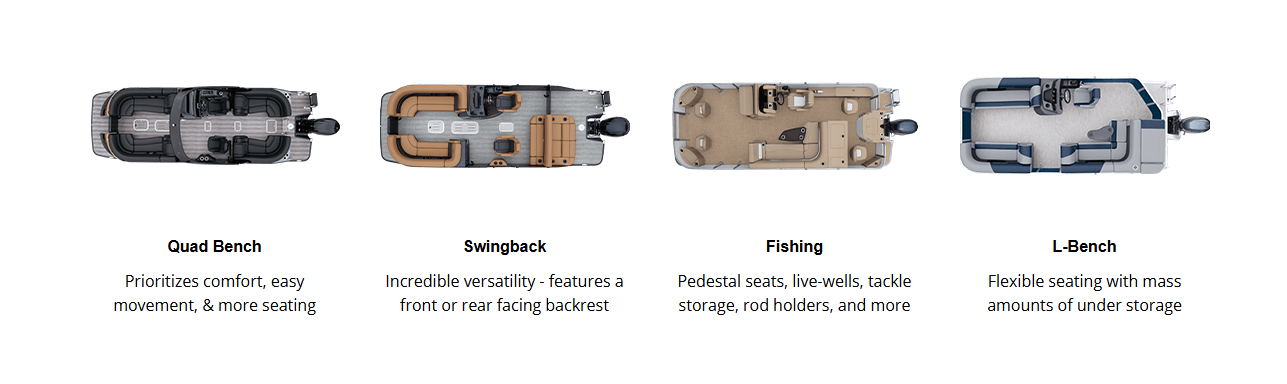
Construction and materials also matter. Differences in hull construction, decking, pontoon tubes, furniture, hardware, storage, livewells, and other components aren't always obvious when you're walking around a showroom.
That's why comparing boats based only on length and appearance can be misleading.
What Are You Actually Paying For?
Features are another place where boat prices can spread out quickly.
Depending on the model, you may be comparing things such as:
- Basic versus premium seating
- Standard versus upgraded flooring
- Manual versus power Bimini tops
- Basic versus premium audio systems
- Different electronics packages
- Larger or upgraded fishfinders
- Trolling motors
- Additional lighting
- More storage
- Performance upgrades
None of these features are automatically worth paying more for. The question is whether they're worth paying more for to you.
If you're on the water every weekend fishing, investing in better electronics or a trolling motor may be money well spent. If your boat is primarily a place for your family to relax, you may get more value from comfortable seating, shade, sound, and usable space.
The most expensive option isn't always the best value. The best value is the equipment you'll actually use.
Don't Forget the Trailer
A trailer is easy to overlook when you're focused on the boat itself. When comparing prices, make sure you know whether the trailer is included and what you're actually getting.
A trailer needs to be properly matched to the boat's size and weight. Depending on the boat, you may also want to consider features such as brakes, tires, lighting, construction, and ease of launching and loading. If you're going to trailer your boat regularly, the trailer is an important part of the purchase, not an afterthought.
What Other Costs Come With Buying a Boat?
The purchase price isn't the end of the budget. You'll also want to think about the ongoing costs of ownership.
Taxes and registration vary depending on where you live.
Insurance depends on the boat, coverage, location, and other factors. Getting an insurance quote before you purchase can help prevent surprises.
Fuel depends on how often you use the boat, the engine, how fast you run, how much weight you're carrying, and the type of boating you do.
Storage can range from keeping the boat at home to renting outdoor, covered, or indoor storage.
Maintenance is another cost every boat owner should plan for. Oil changes, winterization, batteries, propeller maintenance, trailer maintenance, cleaning, and other routine care all add up over time.
One of the best ways to control those costs is to stay ahead of maintenance.
Maintenance costs less than repairs!
How Much Should You Spend on a Boat?
There isn't a universal rule that says you should spend a certain percentage of your income on a boat. Instead, look at the complete cost of ownership and decide what fits comfortably into your budget.
Think about the down payment, monthly payment, insurance, fuel, storage, maintenance, registration, and the occasional unexpected expense. A boat should add enjoyment to your life not financial stress. It's also worth deciding on your budget before you fall in love with a boat.
Give yourself three numbers to work with:
Comfortable budget: What can you spend without putting pressure on the rest of your finances?
Ideal budget: What would you like to spend to get the features and capabilities that matter most to you?
Maximum budget: What's the absolute most you're willing to spend?
Having those numbers in mind makes it easier to compare boats objectively.
Should You Buy the Most Expensive Boat You Can Afford?
Not necessarily. It's easy to assume that spending more automatically means getting a better boat. Sometimes it does mean getting more features, more performance, better materials, or additional space. But if you're paying for features you won't use, you may not be getting much additional value.
At the same time, buying too small or underpowered can create its own problems. The goal is to find the sweet spot between what you want, what you need, and what you're comfortable spending.
The best boat isn't the biggest boat or the most expensive boat. It's the boat that fits your boating lifestyle.
So, How Much Does a New Boat Really Cost?
The honest answer is: it depends.
You can find new boats in the $20,000 range, while other boats cost $40,000, $60,000, $100,000 or considerably more. But the number on the price tag doesn't tell the whole story.
When comparing boats, look at the complete picture:
- Size and passenger capacity
- Hull and construction
- Engine and horsepower
- Features and equipment
- Electronics
- Trailer
- Warranty
- Intended use
- Storage
- Maintenance
- Long-term ownership costs
A good boat purchase isn't about finding the cheapest boat or buying the most expensive one.
It's about finding the boat that gives you the right combination of features, capability, quality, and cost for the way you plan to use it. And if you're not sure what that looks like yet, that's okay.
One of the best things you can do before buying is simply ask questions, compare your options, and take your time understanding what you're actually paying for.
That's a much better place to start than simply shopping by price.